

On Gop Hill, overlooking the village of Trelawnyd, you will find Y Gop. Y Gop (or The Gop in English) is a Neolithic monument over 5,500 years old. This colossal man-made mound, the largest prehistoric earthwork in Wales and the second largest in Britain, stands as a testament to the ingenuity and enduring legacy of our Neolithic ancestors. But what is Y Gop and why did they create it?
The views from the top of Gop Hill are breathtaking, stretching across the Clwydian Range, the North Wales coast and Eryri (Snowdonia). It’s easy to imagine the generations who have stood in this very spot, each with their own stories and beliefs tied to this powerful landscape.
One persistent legend associates Y Gop Hill with the final battle and resting place of the legendary Iron Age Queen Boudicca. While most historians consider this unlikely, wouldn’t it be amazing if this were true and Boudicca is buried just beneath one of my favourite dog walks!
Y Gop Walk Route Map – Under an Hour for Stunning Views!

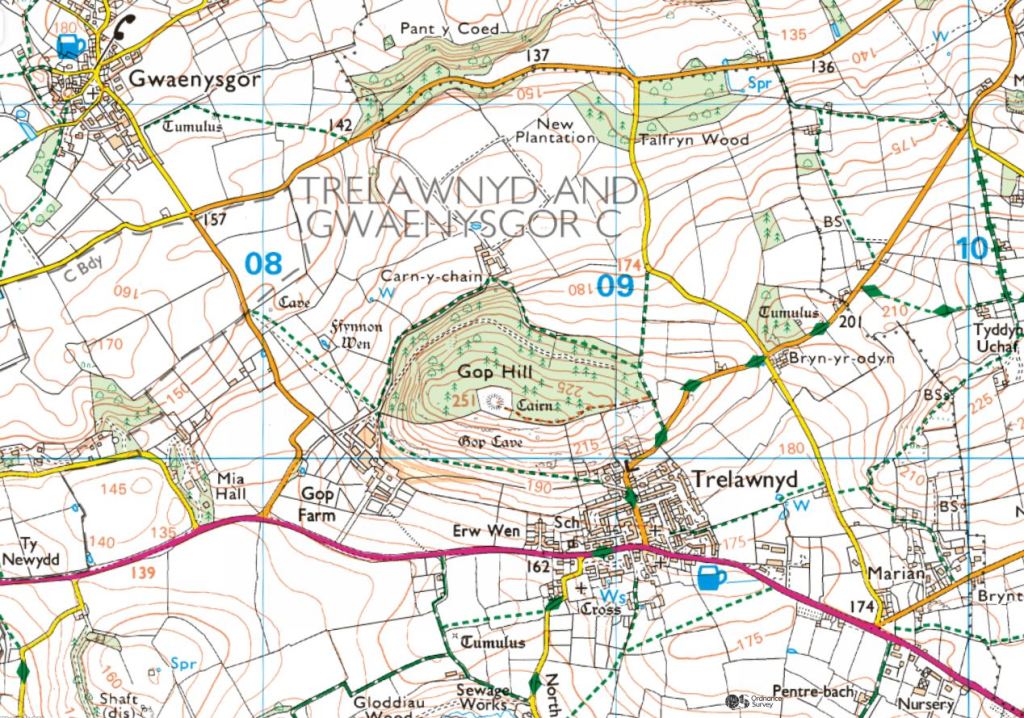
The walk is not very long (you can do it in 30 mins) and perfect for families or if you want a quick walk and a stunning view. It’s an ideal sunrise and sunset walk too.
Where to park to walk up Y Gop

The route starts in the small village of Trelawnyd, there is a small car park on ‘High Street’ and also lots of on road parking to get to the start of the route – click here for a google map

What is Y Gop? Burial Mound, Beacon or Ritual Site?
Y Gop is a large, man-made mound constructed during the Neolithic period (between 4000 and 3000 BC).Standing on top of Gop Hill, this impressive ancient earthwork measures approximately 100 meters wide and 14 meters high. Its sheer scale begs the question of how such a monumental feat was achieved with rudimentary tools and techniques available during the Neolithic period (4000-3000 BC). Intriguingly, despite its imposing presence, excavations back in the 1800’s, revealed the mound isn’t a burial chamber itself. Its true purpose remains a mystery, sparking speculation about its use as a landmark, a ritual site, or perhaps simply a beacon.

Y Gop Caves
Beneath Y Gop Hill lie the Gop Caves. These caves have provided invaluable insights into the prehistoric life that once thrived in this region. Excavations have brought to light:
- Pleistocene Animal Remains: Bones of long-extinct animals such as woolly rhinos and bison
- Mesolithic Stone Tools: Evidence of early human occupation, suggesting the presence of hunter-gatherer communities in the area.
- Neolithic Human Burials: The remains of 14 individuals, alongside distinctive pottery and a polished stone axe, firmly place the burials within the Neolithic era.
- Neolithic Artifacts: A beautiful, unused polished stone axe, originating from the nearby Graig Lwyd axe factory, hints at the skilled craftsmanship and trade networks of the Neolithic period.
Why does Y Gop have a crater at the top?

The ‘crater’ at the top of Y Gop, the largest ancient mound in Wales, is the result of archaeological excavations.
The Gop Cairn was explored in the late 19th century (1886-87) using a central shaft sunk from the top, and two tunnels from the base. While these excavations did not uncover the cairn’s original purpose or any burial chamber, the shaft created the indentation seen on the mound today.
I find it amazing that such a large burial mound has not been excavated more recently – I bet there are masses of things we can learn about why it was created and the battles that have apparently taken place on it. The area was also historically known as Bryn-y-Saethau, meaning ‘Hill of the arrows’, due to the numerous flint arrowheads found there
Leave a Reply